Bialetti induction moka pot
FEATURES
- Upper part made of food-grade aluminium alloy. Heater made of steel (outside part suitable for induction hobs) and aluminium alloy (inside part suitable for food use).
- Ergonomic handle and knob in thermoplastic material.
- Inspection safety valve
- Made in Romania.
- Suitable for all hobs.
Some surface flaws are due to the handcrafted production process and do not jeopardize the quality and the operation of the product.
MAKING COFFEE
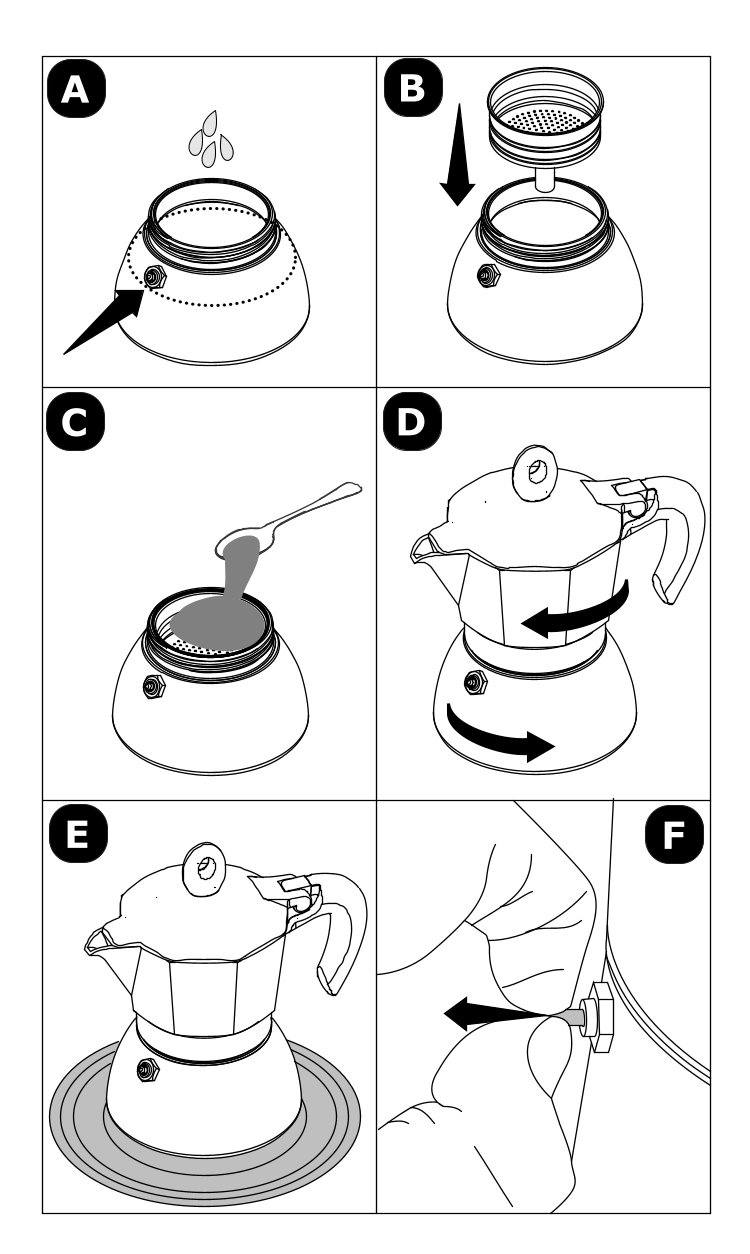
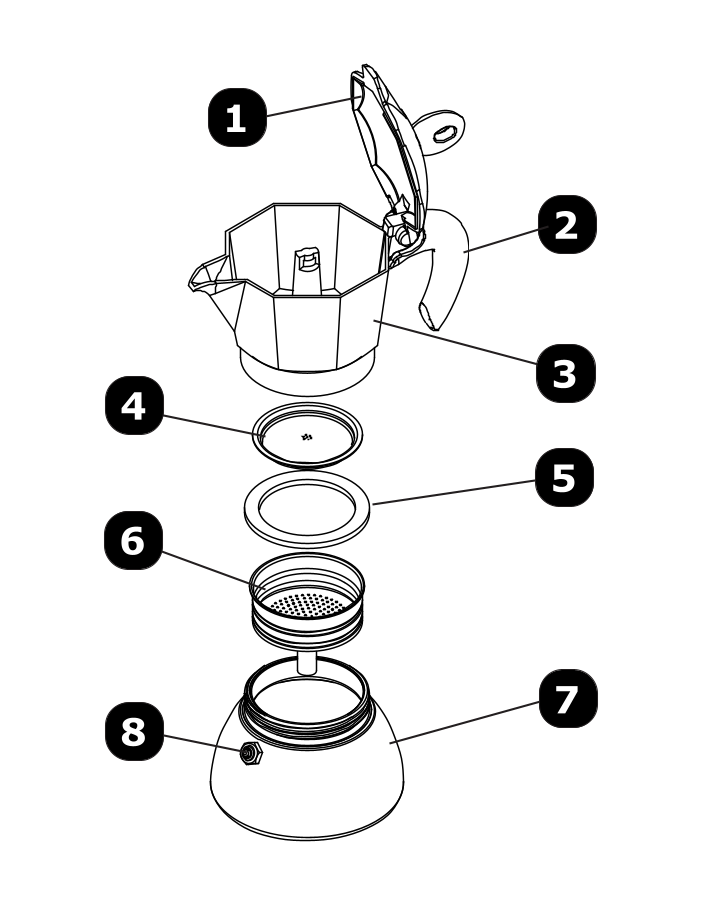
- Fill the heater (7) with cold water up to the lower edge of the safety valve (8), Fig. (A).
- Insert the funnel filter l(6) into the heater (7) Fig. (B).
- Fill the funnel filter © with ground coffee for Moka, without pressing it down, taking care not to leave coffee powder on the edge of the coffee maker, Fig©C).
- Screw the upper part (3) on the heater (7) and tighten well, without pressing too much and avoiding to force the handle (2), Fig. (D).
- Put the coffee maker on the heat source. In case of flame, keep it low so that it does not go beyond the rim of the coffee unit. In case of induction/electric/ceramic glass plate, do not use the highest heat, Fig. (E).
- When the upper unit (3) is full of coffee, remove the coffee maker from the heat source and pour. BIALETTI INSPECTION SAFETY VALVE (8) The Bialetti valve has been patented and designed to guarantee the use of the coffee maker in complete safety. Using the coffee maker with drinking water might entail the risk of formation of lime scale in the hole of the valve, causing its clogging. To avoid clogging arising from lime scale, just move the small piston coming out of the valve along its axis during the normal washing oper- ations, Fig. (F). It is advisable to carry out this inspection periodically to ensure its proper operation. The safety valve is a protective element and should intervene only in conditions of abnormal operation or use of the coffee maker.
FAQ
The safety valve vents:
- Make sure coffee used is ground coffee for Moka.
- Make sure it is not pressed into the funnel.
- Make sure there is not too much water in the heater.
- When using the induction plate, check whether a too high power or the boost function have been used. If the phenomenon still remains, it could signal a malfunctioning, therefore do not use the product and contact the dealer. The coffee maker leaks water:
- Check proper tightening of the coffee maker.
- Check the gasket for wear and replace, if necessary.
- Make sure there is no coffee powder residues on the edge of the heater. The coffee maker does not dispense coffee:
- Check the presence of all parts.
- Check proper tightening of the coffee maker.
- Check the coffee maker for leakage. The coffee is cold/too hot:
- Check the proper level of water, which must be at the same level as the bottom edge of the valve. The coffee maker changed colour:
- the coffee maker has remained on the heat source for too long. Anyway, this does not jeopardise the use of the product. The coffee maker does not activate on the induction hob:
- For the use on induction, check the compatibility of the diameter of the coffee maker heater with the technical features of the hob.
CLEANING AND MAINTENANCE
- Before carrying out cleaning and maintenance, wait for the ap- pliance to cool completely.
- It is advisable to clean the coffee maker in all its parts, including the dispensing column, which must be free from coffee powder obstructions.
- After each use, wash with warm water without detergents and/ or abrasive materials (the product CANNOT be put in the dish- washer).
- Store the product perfectly dry in all its parts and not closed to prevent any build-up of stains/oxidations.
- Regularly perform the decalcification procedure:
- Fill the heater (7) with water up to the level, Fig. (A).
- Add two teaspoons of citric acid or vinegar.
- Reassemble the product and, without adding the coffee powder, dispense once.
- Throw away the solution obtained.
- Wash the coffee maker with current water and make coffee.
- Regularly check that the holes of the filter plate (4) are not obstructed, otherwise open them using a brush with delicate bristles or a needle.
- Periodically check the internal components and, in case of wear- ing or damage, replace them only with original Bialetti spare parts suitable for the model used. Replace the gasket (5), if worn. It is recommended to replace it at least once a year anyway.